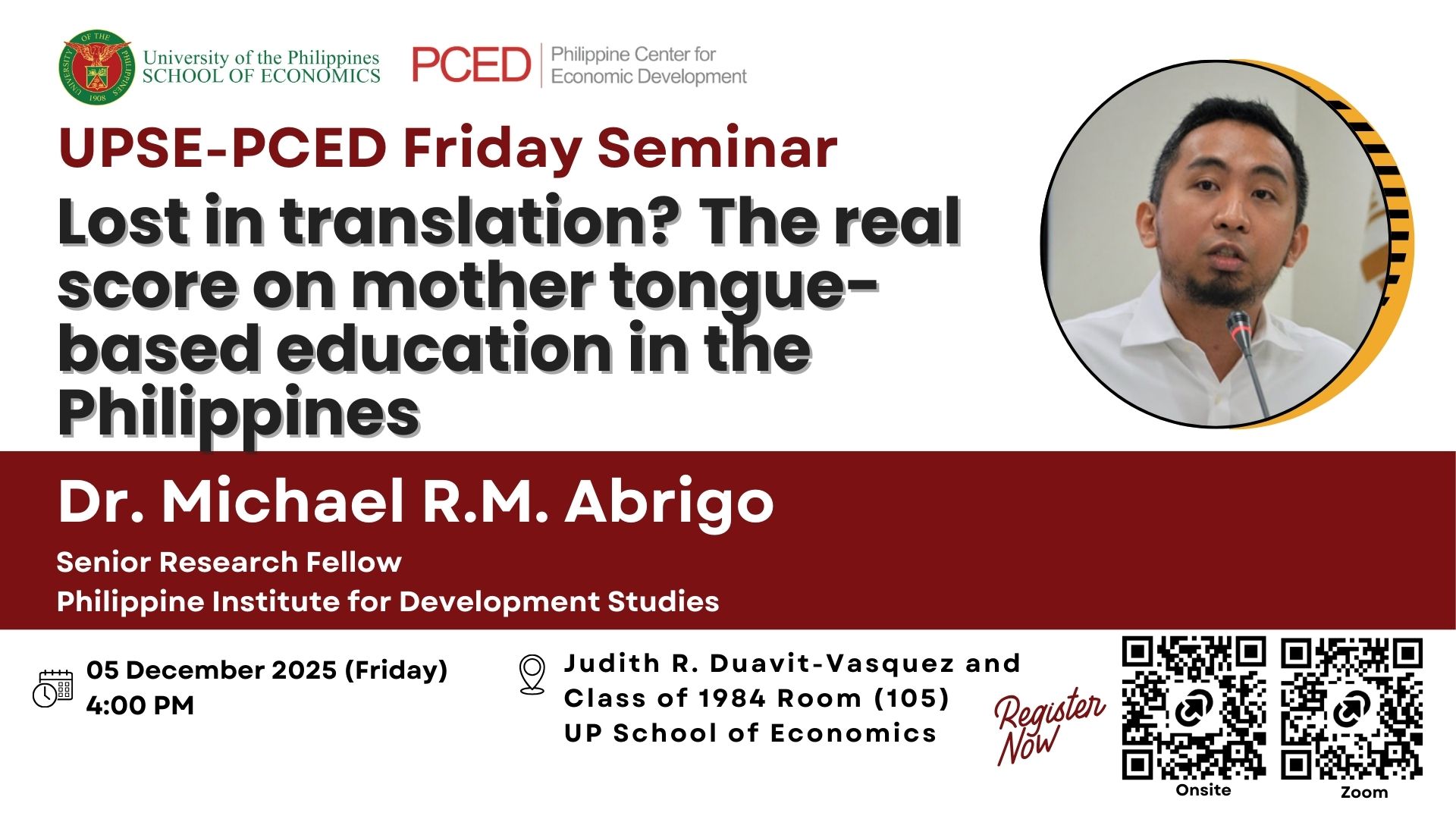
ABSTRACT
This paper reexamines the impact of the Philippines’ Mother Tongue-Based Multilingual Education (MTB-MLE) policy on schooling outcomes and resource allocation in basic education. We conceptualize language mismatch between students’ mother tongues and schools’ language of instruction as an efficiency wedge that distorts the efficient translation of education inputs into learning, analogous to a tax on productivity. Using school-level administrative and assessment data merged with pre-policy linguistic distributions, we estimate a shift-share instrumental variable difference-in-difference and triple-differences design embedded in an event-study framework. Our identification strategy exploits exogenous variation in local language composition and the timing of the MTB-MLE rollout to isolate the causal effect of mother tongue-instructional language matching on student performance. We find that language matching improves early grade learning outcomes in Mathematics, English and Filipino. Improved language matching also corresponds to measurable gains in cohort survival that more than offsets the pre-policy disadvantage among those affected schools. These findings highlight the importance of effective language policy not merely as cultural preservation but as an economic coordination problem in human capital formation.
————————————————–
The Economics Research Center is pleased to announce its full lineup of speakers from September to December 2025.
DECEMBER
5 – Mike Abrigo (PIDS)
10 – JC Punongbayan (UPSE)
11 – Kurt Gerrard See (National University of Singapore)
12 – Justin Eloriaga (Emory University)